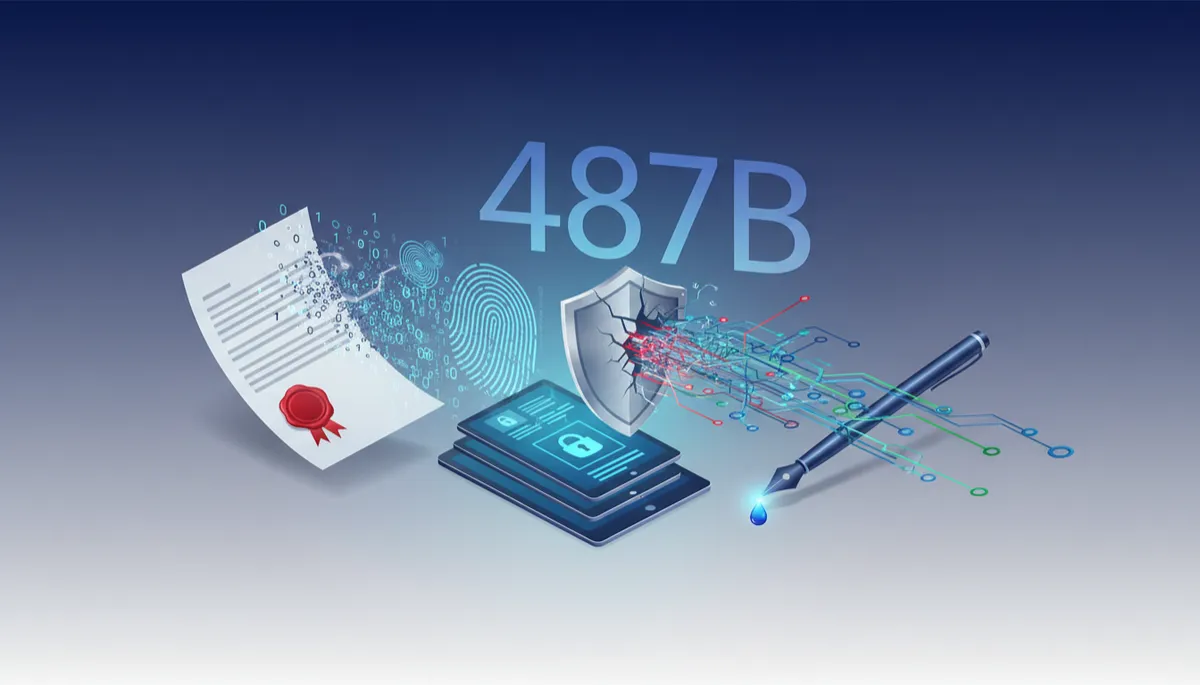
The $487 Billion Cost of Paper-Based Trust
Fraud Prevention, Digital Notarization, Executive Risk Management
$487 Billion: The Silent Cost of Paper-Based Trust
Document and identity fraud are no longer edge cases; they are a systemic, global drain on wealth and reputation. While estimates vary, credible reports place annual fraud losses in the hundreds of billions of dollars. Whether you quote $442 billion, $579.4 billion, or $487 billion, the conclusion is the same: paper-era notarization is outmatched, and high-value transactions are exposed.
Document and Identity Fraud Are Now Executive Risks
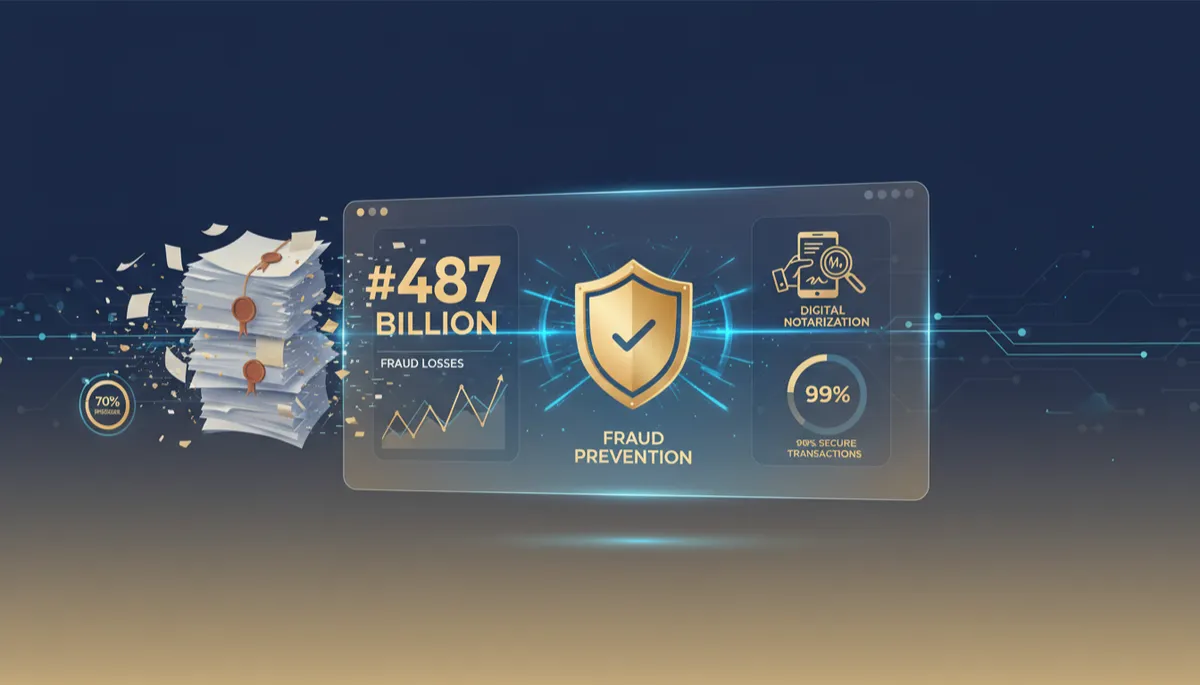
Fraud is no longer a background IT issue; it is a board-level threat. TransUnion reports that one in six U.S. consumers lost money to digital fraud in the past year, with a median loss of $2,307 per victim, and 26% of global consumers reporting monetary loss. Identity fraud alone accounted for $27.3 billion in losses and 18 million victims in 2025, according to Javelin Strategy & Research. That is before you factor in the hidden cost of forged contracts, fake identity documents, and credential fraud across high-value sectors like aviation, maritime, and luxury real estate.
Document fraud is accelerating. Turing Verify’s 2026 data shows that 11% of submitted documents were forged or unverifiable, with academic credentials being the most frequently faked. Generative AI has made it trivial to manufacture convincing forgeries and synthetic identities, while detection methods struggle to keep pace. For an executive closing a multi-million dollar deal, a single bad actor armed with a fabricated identity or altered document can quietly convert a transaction into a liability.
Traditional Notarization: A Ritual Without a Record
Traditional notarization was designed for a slower, analog world: wet ink on paper, a stamp, a journal entry—often handwritten, often incomplete. Once the ink dries, the transaction disappears into filing cabinets, scan folders, and offsite storage. Critically, the process leaves almost no meaningful digital trail of who appeared, what they presented, and how their identity and documents were evaluated in real time.
For high-net-worth individuals and institutional clients, this is a structural weakness. A stamped page does not tell you whether the ID was forged using AI, whether the signer was being impersonated, or whether the document was quietly altered after signing. There is no cryptographic fingerprint, no tamper-evident audit log, and no independent time-stamping. When a dispute arises months later, you are left arguing over memories and paper, not provable facts.
Fraudsters Understand the Gap. It’s Time You Did Too.
Modern fraudsters are disciplined, data-driven operators. INTERPOL’s 2026 assessment points to a global surge in synthetic identity fraud, often powered by AI. Entrust’s 2026 Identity Fraud Report details how attackers now combine forged documents, deepfake biometrics, and automated attacks to overwhelm traditional verification.
These actors deliberately target weak points in the chain of trust: in-person signings with no forensic capture, paper-based workflows that can be swapped or reprinted, and notarizations that cannot be independently verified. In other words, they exploit the fact that traditional notarization generates no rich, verifiable digital trail. Once a fraudulent document is stamped, it can circulate as “proof” across banks, registries, and counterparties, carrying your name and risk profile with it.
📌 Key Takeaway: Fraudsters are scaling with AI and automation while many high-value transactions still rely on paper-era notarization that cannot prove what actually happened.
Why a Digital Trail Is Now Non‑Negotiable
In this environment, a notarization without a digital trail is a security risk. A modern, defensible trail should capture:
Document integrity: cryptographic hashes of every page, so any post-signing alteration becomes immediately detectable.
Identity verification: biometric and device-level signals, checked by AI for deepfake and forgery indicators, and bound to the notarization event.
Chain of custody: an immutable log of who accessed, viewed, or transferred the document and when.
Independent time-stamping: anchored to a public, tamper-resistant ledger rather than a private, editable system.
Without these elements, you may have signatures—but you do not have proof. For executives stewarding yachts, aircraft, or multi-million-dollar properties, that distinction is material.
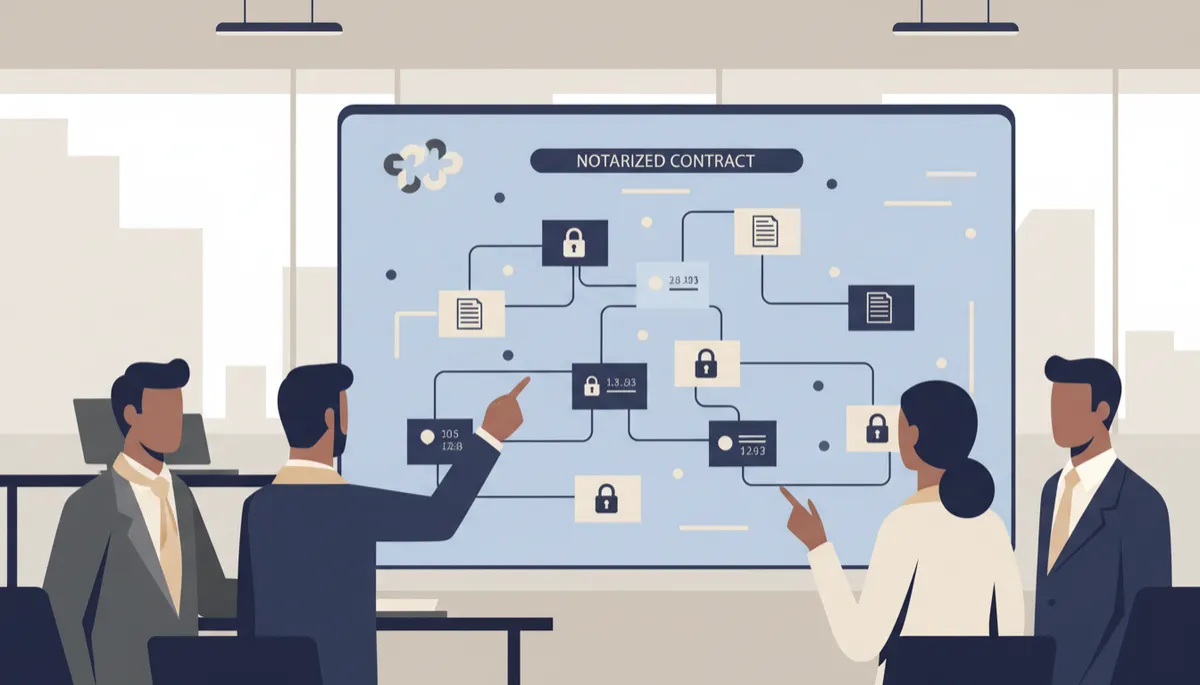
A forensic, blockchain-backed audit trail turns notarization into defensible, provable evidence.
How NotaryChain Redefines Notarization for High-Stakes Transactions
NotaryChain was built for this new risk landscape. As a blockchain-based notary platform, it replaces opaque, paper-first workflows with AI forensic analysis and Hedera public blockchain anchoring to deliver tamper-proof, biometrically verified, cryptographically sealed documents.
AI forensics scrutinize IDs, faces, and documents for signs of manipulation, deepfakes, or synthetic identities before a notarization is completed.
Every notarized document is hashed and anchored to Hedera’s public ledger, creating an immutable, time-stamped proof of existence and integrity.
A full digital trail—identity checks, device signals, document versions, and access events—is preserved, providing chain-of-custody clarity that paper can never match.
💡 Pro Tip: Treat notarization as a security control, not a checkbox. Demand forensic evidence, immutable logs, and independent verification for every high-value document.
From Ritual to Risk Control
Annual fraud losses measured in the hundreds of billions are not abstract statistics; they are failed controls, compromised identities, and forged documents that slipped through traditional defenses. Fraudsters understand precisely where analog notarization is weakest. NotaryChain exists to close that gap—delivering uncompromising document security and chain-of-custody integrity for clients who cannot afford uncertainty.
In a world where AI can fabricate identities in seconds, the question is no longer whether you can obtain a signature. It is whether, months or years from now, you can prove that signature, that identity, and that document beyond reasonable doubt. With NotaryChain, the answer is designed to be yes.
📌 Key Takeaway: If your next closing, vessel transfer, or aircraft sale still relies on paper-era notarization, you are accepting avoidable risk.
✅ Schedule a confidential NotaryChain risk consultation today to benchmark your current notarization process, identify exposure across your South Florida transactions, and implement AI‑forensic, Hedera‑anchored notarization before the next deal closes.
